
REDMOND, WA / SAN FRANCISCO, CA — January 15, 2032
OpenAI, Inc. and Microsoft Corporation today announced a definitive agreement to merge in an all-stock transaction valuing the combined entity at approximately $18.2 trillion. The combined company will operate under the OpenAI name. Satya Nadella and Sam Altman, both now serving as co-Chairmen, issued a joint statement calling the deal “the natural conclusion of a partnership that began with a $1 billion bet in 2019.”
“We spent thirteen years trying to figure out where one company ended and the other began,” said Altman. “The answer, it turns out, is that there was never a line. There was just a billing dispute.”
The merger combines OpenAI’s 2.8 billion monthly active users and $340 billion advertising and subscription business with Microsoft’s $490 billion Azure cloud infrastructure and enterprise portfolio. The deal comes six months before Microsoft’s perpetual IP license to OpenAI’s models expires under the 2025 restructuring. Rather than renegotiate, both boards chose integration. “The divorce papers were drawn up,” Nadella said. “We decided to renew our vows instead.”
The merger is the third mega-combination of the AI era, following Musk’s $1.25 trillion SpaceX-xAI consolidation in 2026 and Tesla’s subsequent absorption. Advisors to the deal described it as a direct response to Alphabet, the only company that still owns the full AI stack—models, cloud, chips, ads, and three billion mobile devices. “Google was always the final boss,” one told the Financial Times. “You don’t beat a vertically integrated opponent by staying horizontal.”
How we got here
That press release is fictional. But I think it’s plausible—maybe even likely. And the story of how we get from February 2026 to that January 2032 headline runs through three developments that almost nobody is pricing correctly right now: a billion-user product that people are underestimating, an advertising engine that will rewrite the economics of AI, and the return of the American mega-conglomerate. Let me walk you through each.
900 million reasons
Right now, in February 2026, the consensus on OpenAI is bearish. Anthropic just closed its $30 billion round at a $380 billion valuation. Claude is winning developer mindshare so decisively that SemiAnalysis wrote a line that still stings: “Claude for Excel is effectively what Copilot for Excel should have been.” Google’s Gemini surged from 5.7% to 21.5% of AI web traffic in a single year while ChatGPT’s share fell from 86.7% to 64.5%. OpenAI is projecting $14 billion in losses this year. The vibes, to use the technical term, are not good.
The bear case writes itself: OpenAI peaked. They haven’t pretrained a genuinely new foundation model since GPT-4 in March 2023. Everything since—GPT-4 Turbo, 4o, even GPT-5—has been post-training iteration on that same base. GPT-4.5 was a failed run. Altman keeps getting distracted by chips and energy and space. The company that started the AI revolution is losing its edge to two players with better focus and deeper research cultures.
But look at the absolute numbers. ChatGPT has 900 million weekly active users as of January 2026. Approaching a billion. Facebook needed eight years to reach a billion monthly actives. Instagram needed a decade. ChatGPT is on pace to do it in three. The bears see declining market share and say weakness. What actually happened is that the whole category exploded and ChatGPT’s “declining” 64.5% still represents four times more users than it had a year ago. That’s not a product in decline. That’s a utility taking shape.
Consider this: OpenAI has so many users they couldn’t even deprecate GPT-4o without an uproar. Almost a billion people have built their daily workflows around this thing. You don’t have a user base at that point. You have an installed base. You have infrastructure.
And then there’s GPT-6. By mid-2026, OpenAI will be training on over 2 million chips in the Stargate complex—more than 5 gigawatts dedicated to a single run. The near three-year drought since GPT-4 is about to end. While everyone was writing eulogies, OpenAI was building the largest training infrastructure ever assembled. The cannon is loaded.
The Ad engine nobody saw coming
But the real story—the one I think rewrites the entire trajectory of this company—started nine days ago, on February 9, 2026, when OpenAI launched advertising in ChatGPT.
Predictable reactions ensued. The enshittification crowd howled. Anthropic ran a Super Bowl ad: “Ads are coming to AI. But not to Claude.” Tech Twitter and Reddit declared it the beginning of the end. From the vantage point of 2032, that Anthropic ad is going to look like the company that chose purity over scale—and learned what that costs.
The launch looked deliberately unimpressive: $60 CPMs, a $200,000 minimum commitment (and $1M max), no targeting, no real measurement—just impressions and clicks. The same playbook Netflix used. The same playbook early Facebook used. And that’s the tell. If you assume these people are smart—and they hired Fiji Simo from Meta, acquired StatSig for experimentation, and staffed the whole ads org with the people who literally built Meta’s machine—then every move starts to look like signal maximization. The CPM pricing lets them collect data without making performance promises. The 4% affiliate fee on in-chat purchases bootstraps transaction data. The absence of targeting levers means they’re not committing to a system that hasn’t been trained yet. They know exactly what they’re building. They’ve built it before.
What they have that no advertising platform has ever launched with: an interest graph of 900 million people who tell the product everything about their lives. Not what they click on. Not what they passively scroll past. What they ask for, what they worry about at 2am, what they’re planning to buy, what they need help deciding. Google and Meta infer intent from behavior. ChatGPT’s users hand it to them in natural language, multiple times a day.
And here’s the part the enshittification crowd will never grasp: the ads don’t need to touch the chat context at all. As one early ads executive put it: “It knows I’m a brown tech guy in San Francisco. It can serve me jeans without caring about what I’m asking it right now.” The interest graph is so rich that contextual targeting is beside the point. There’s no conflict between the ad engine and the product because they operate on completely different data layers. The dream of advertising that’s actually useful—the dream the industry has been chasing since 1994—turns out to require a product that knows its users better than they know themselves.
Evercore ISI estimates $25 billion in annual ad revenue by 2030. Given what I’ve laid out, that looks conservative. If this engine matures the way Meta’s did—and it has better starting data—the ad business alone could dwarf subscriptions by the end of the decade.
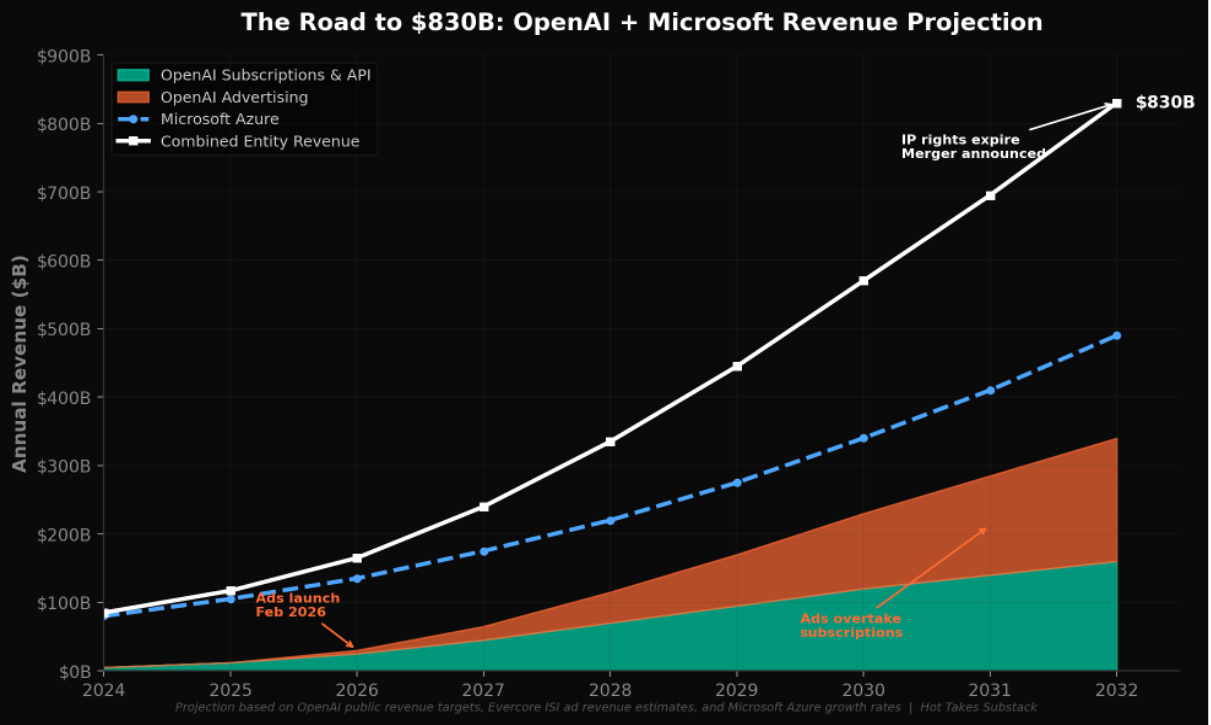
Projection based on OpenAI public targets, Evercore ISI ad revenue estimates, and Microsoft Azure growth rates
The “Baby Bells” theorem
So if OpenAI becomes a money-printing consumer platform and Microsoft is already the biggest cloud on Earth—why merge? Why not just keep the partnership?
Because the technology demands it. This has happened before.
In 1984, the U.S. government broke up AT&T because telephony had become so essential that no single company should control the whole stack. Twenty years later, the Baby Bells had re-merged. SBC acquired AT&T itself and took the AT&T name—the child ate the parent. The breakup hadn’t failed. The technology had simply evolved to where vertical integration was thermodynamically inevitable. A fragmented telephone network in the age of mobile broadband made everyone worse off: consumers, businesses, even the regulators who ordered the split. I highly recommend checking out Asianometry on Youtube, who has researched extensively on the telecom industry through the 20th century.
AI in the late 2020s will reach the same threshold of essentiality. Not in the marketing-copy sense—in the electricity-and-telephony sense. Businesses won’t “adopt AI.” They’ll be constituted by it. And when that happens, the compute-model-distribution stack will want to be integrated for the same reason the telephone network did: because the intercompany friction—the licensing agreements, the revenue sharing, the byzantine accounting—becomes a tax on the entire system.
Now, a reasonable objection: essential infrastructure usually means regulated utility, which means boring, low-margin business. But AI has something telephony never did—compounding network effects. More users create more data. More data improves the model. Better models attract more users. And more users build a richer interest graph, which feeds the ad engine, which funds more compute, which trains better models. AT&T never had that feedback loop. Google does. Which is exactly why Google is the company this entire merger exists to compete with.
The return of the American mega-corp
And that brings us to the structural shift that makes this merger feel not just plausible but inevitable: the mega-conglomerate is back.
The conglomerate had been out of fashion for decades. Jack Welch’s GE was the cautionary tale. The market rewarded focus—pure-play companies with clean narratives and single-segment earnings calls. The 2010s were the decade of the verb: Uber moves, Stripe processes, Zoom connects. One product, one TAM, one S-1.
AI killed that. The defining characteristic of AI as a technology is that it is general-purpose in a way no previous software paradigm was. A search engine does search. A CRM manages relationships. AI does anything. And if your technology does anything, your company has to be organized to deliver anything—infrastructure, distribution, intelligence, data, compute, all vertically integrated, at scale.
Musk understood this first. The SpaceX-xAI merger in February 2026 at $1.25 trillion—the largest in history at the time—followed by Tesla’s absorption in 2028, looked like ego. But the logic was structural: space-based compute, AI for autonomous driving and robotics, Starlink for global distribution, X for the social data layer. The first mega-corp of the AI era.
Google had been one all along—search, cloud, models, TPUs, advertising, Android, Waymo, consumer hardware, productivity software, and numerous other things I’m probably forgetting. Alphabet was the proof that vertical integration worked in AI. The rest of the industry spent the late 2020s trying to match what Google already was.
Apple and Nvidia took a different path. As AI rewired the economy, hardware underwent a terminal value re-rating—the market finally recognized that whoever controlled the silicon controlled the bottleneck. Apple dominated edge and consumer devices. Nvidia dominated the data center. Both stayed publicly traded, standalone, and became the arms dealers to every mega-corp that needed chips. Meta carved its own lane with open-source models, the social graph, and AR/VR.
Which left Microsoft and OpenAI as the obvious next domino—two companies with massive overlap, massive interdependence, and an IP agreement about to expire.
OpenAI’s teenage years
Every parent-child relationship goes through an awkward phase, and OpenAI-Microsoft’s was particularly messy.
The for-profit conversion in late 2024 was the teenager getting a driver’s license. The October 2025 restructuring was the move-out: OpenAI negotiated the right to use other cloud providers, struck deals with Oracle and AWS, and established an IP framework giving it full ownership of its technology by 2032. Microsoft kept its API access, its equity stake, and a $250 billion compute commitment representing 45% of Azure’s revenue backlog. A deal structured by lawyers who believed these companies would always need each other but might not always like each other.
At Microsoft, Copilot’s 3.3% attach rate—15 million paid users out of 450 million M365 seats—was telling a story the company was slow to hear. The market wasn’t rejecting AI in productivity software. It was rejecting Microsoft’s version of it. The foundation model companies were building better experiences on top of Office than Microsoft’s own product teams. M365 was becoming a system of record: the place where data lived, but not where intelligence happened. The value was migrating upward—from the application layer to the model layer.
What Nadella understood—perhaps earlier than anyone gave him credit for—was that this was fine. Azure was growing at 39% with capacity constraints. The $625 billion backlog had doubled year over year. Microsoft didn’t need to win the product layer. It needed to be the infrastructure every product layer ran on.
The Google problem
By 2031, the competitive logic makes the merger unavoidable. Alphabet owns the full stack—frontier models, cloud, chip fabrication, the world’s largest advertising engine, a mobile OS on three billion devices—and every piece reinforces the others. Competing with that while split across two companies, connected by a licensing agreement drafted by lawyers, is like entering a Formula 1 race in two go-karts tied together with rope.
That’s really the whole argument. Google is the only player that doesn’t need a partner. Everyone else does. And Microsoft and OpenAI’s partnership, for all its success, carries friction that a fully integrated competitor simply doesn’t have—licensing negotiations, revenue sharing, duplicate infrastructure planning, quarterly earnings calls where both CFOs spend more time explaining intercompany accounting than actual business performance. Every dollar of that friction is a dollar Google doesn’t spend. Every quarter of misaligned incentives is a quarter Google doesn’t waste. The merger isn’t some grand strategic vision about building a differentiated alternative to Alphabet. It’s a survival decision. Two companies realizing that the rope between the go-karts is costing them the race, and the only move is to get in the same car.
What makes it interesting is that survival decisions, when the underlying assets are this strong, tend to produce something bigger than what either party intended. A $340 billion consumer AI platform fused with a $490 billion cloud infrastructure business, with no intercompany licensing overhead and compute at cost provides more than just competitive with Google. It’s perhaps the only entity on Earth that can look at Alphabet’s full stack and say, credibly, “we have one too.” (I say “credibly” since I guess Elon will have the mega X corporation).
The line that was never really there
America has always rewarded the ability to turn massive upfront investment into sustainable profit. Railroads did it. Oil did it. The internet did it. And AI—after nearly a decade of the biggest capital expenditure cycle in corporate history—is about to do it.
OpenAI’s path from nonprofit research lab to the largest company in the world is the most compressed version of that story ever told. Thirteen years from founding to $830 billion in combined annual revenue. From “they haven’t pretrained a new model since GPT-4” to the platform that 2.8 billion people use to think, shop, work, and decide.
In February 2026, the consensus says OpenAI is overextended, under differentiated, and about to be overtaken. Anthropic is the darling. Google is the inevitable winner. The ads launch is a sign of desperation.
Six years from now, two companies that spent thirteen years figuring out where one ended and the other began will finally accept the answer.
There was never a line. There was just a billing dispute.
Now, about those Amazon-Anthropic merger talks…
Disclaimer
This piece is entirely fictional and speculative. It does not reflect the views, plans, or strategies of any company mentioned, including the author’s employer. All projections are extrapolations based on publicly available data as of February 2026 and should not be interpreted as financial advice, investment recommendations, or insider information. The future described here is one of many possible futures, and almost certainly wrong in most of its specifics.
That said, the billing dispute part feels pretty inevitable.